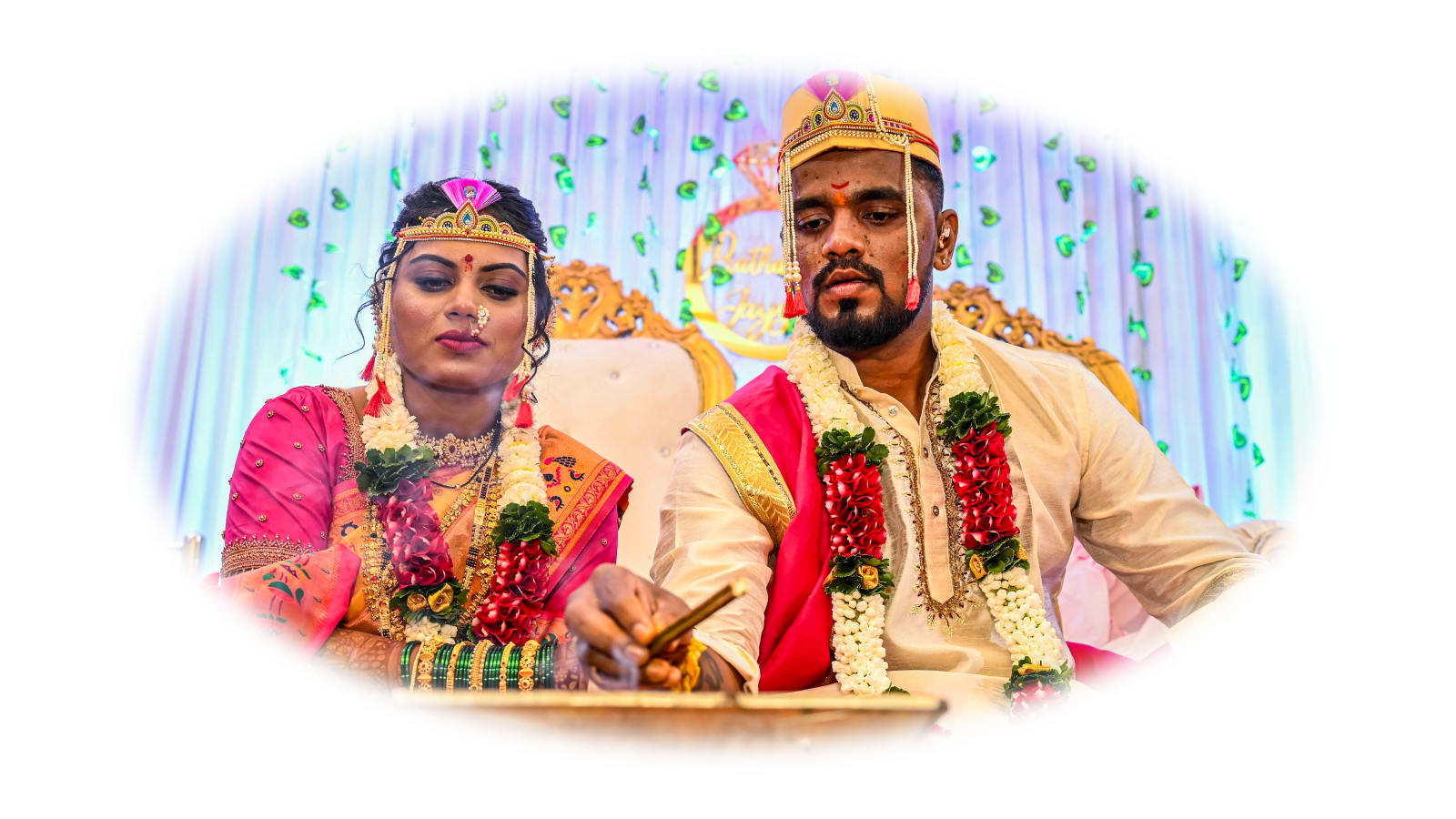
From Ganesh Puja to the Saptapadi, what actually happens at a Hindu wedding and what each ritual means — without the Sanskrit overload.
The Baraat team5 May 20266 min read
Hindu wedding ceremonies are layered. They are also, depending on which family you've come from, long. Two hours is short. Three to four hours is normal. Five hours is not unheard of. The reason is that Hindu weddings are stitched together from many smaller rituals, each one with its own mantras and meaning, accumulated over centuries.
For couples planning the day — and for guests trying to follow along — it helps to know the structure. This guide walks through a standard North Indian Hindu wedding from the moment the baraat arrives to the moment the bride leaves. There are regional variations (Gujarati, Tamil, Bengali, Marwari weddings each have their own emphases), but the spine is the same.
The arrival: Baraat and Milni
The wedding doesn't begin in the venue. It begins on the street outside.
The groom arrives in the baraat — a procession with dhol players, the groom's family dancing, sometimes the groom on a horse. The procession can be 30 minutes of pure joy. Then he stops at the entrance.
The bride's family meets the groom's family at the door. This is the Milni — a formal introduction with garlands. The groom's father is welcomed by the bride's father, the brothers by the brothers, and so on. Each pair garlands each other and embraces. It's the moment the two families meet as in-laws for the first time.
After the Milni, the groom is brought to the mandap (the canopied wedding altar) where the bride's mother performs aarti (a small flame ceremony) and applies tilak (a red mark) on his forehead.
The setup: the mandap
The mandap is a covered structure with four pillars. Inside is a small havan kund — a sacred fire pit — in which the priest tends a fire throughout the ceremony. The fire (Agni) is the witness to the marriage; it is more important than any registry signature.
The bride and groom sit facing the priest, with parents and immediate family seated around the . Guests sit in rows facing the .
Every Hindu ceremony begins by invoking Ganesh, the remover of obstacles. The priest performs a short prayer to Ganesh on a small shrine to one side of the mandap. The couple is sometimes asked to participate — placing flowers, offering rice.
2. Kanyadaan (10–15 min)
The bride's father formally "gives" his daughter to the groom — though the modern reading is more an entrustment than a gift. Both the bride's parents pour water into the joined hands of the bride and groom, while the priest recites mantras. Often emotional; many fathers cry here.
3. Hasta Milap / Granthi Bandhan (5 min)
The bride's dupatta is tied to the groom's scarf — the granthi knot. This signifies the union of the two souls.
4. Vivah Homa / Havan (15 min)
The fire is intensified. The priest invokes Agni and other deities, with the couple offering ghee and grains into the fire while reciting mantras. This is the longest Sanskrit portion of the ceremony for many guests; it can feel like nothing's happening for a while. Don't worry — it's the spiritual frame for everything that follows.
5. Mangal Pheras — the four circles (15–20 min)
The couple, now physically tied together by the granthi, walks four times slowly around the fire. The bride leads in the first three; the groom leads in the fourth. Each circle represents one of the four life goals in Hindu thought:
*Dharma* — duty and righteousness
*Artha* — prosperity
*Kama* — love and pleasure
*Moksha* — liberation, spiritual fulfilment
After the fourth phera, the couple sits down. They are now married, but several rituals remain.
6. Saptapadi — the seven steps (10–15 min)
This is the emotional heart of the ceremony. The bride and groom take seven steps together — sometimes around the fire, sometimes on betel leaves placed in a row — with each step accompanied by a vow. The vows vary by region but commonly cover:
To nourish each other
To grow in strength together
To preserve wealth wisely
To share happiness and family
To raise virtuous children
To live long together
To remain lifelong companions
7. Sindoor Daan and Mangalsutra (5 min)
The groom applies sindoor (vermilion) to the parting of the bride's hair, and ties the mangalsutra — a black-and-gold beaded necklace — around her neck. These are the visible signs that she is now married. (In many modern UK ceremonies, this is the most photographed moment, so allow space around the mandap.)
8. Ashirvad — blessings (15–25 min)
Family elders come up to the mandap in turn to bless the couple, place rice on their heads and feet, and present small gifts or envelopes. This can be a long line — for a 300-guest wedding, expect 30–50 close family blessings.
9. Vidaai — the bride's farewell (10 min)
The closing ritual. The bride leaves her parents' "side" and joins the groom's. She throws back rice over her shoulder — a symbolic repayment for everything her parents gave her. There are tears. There are always tears. Hire a videographer who knows what to film here.
What guests should know
The ceremony is long. A four-hour ceremony is normal. You do not have to sit through every minute. It's culturally fine to step out for tea, return for the pheras and Saptapadi, and stay for the Vidaai.
Dress modestly but joyfully. Indian weddings are saturated with colour. Avoid pure white (mourning) and red (the bride). Anything else, brighter the better.
*Don't sit with your feet pointing at the mandap.* Sit cross-legged or with knees folded.
Take your shoes off if the ceremony is on a raised stage or carpet area.
Photographs. Most guests stand at the back to photograph the pheras. Don't crowd the mandap — the photographer cannot work and the family cannot see.
Cash gifts in a shagun envelope (£21, £51, £101 — odd numbers; never round figures, which are considered inauspicious) are the standard wedding gift in most communities.
Timing it well
The single biggest mistake couples make is not building enough buffer between the ceremony and the reception. A ceremony scheduled to "end at 2pm" with a reception starting at 6pm sounds generous. In practice, the ceremony runs to 3pm, the Vidaai and photographs to 4pm, and the bride needs an hour to change outfits and redo makeup. Suddenly you are an hour late to your own reception.
Build a 90-minute buffer between the ceremony's expected end and the reception's start. Use that time for photographs and for the bride's outfit change.
A word on the priest
The priest will set the pace of the ceremony. Some priests run a brisk, family-friendly 90-minute ceremony with English explanations between each ritual. Some run a four-hour ceremony entirely in Sanskrit with no commentary.
Talk to your priest in advance. Tell them how long you want, whether you want English commentary, and which rituals are non-negotiable for your family. Most are happy to compress; many are happy to expand. None are happy to be surprised on the day.
If you want a fully tradition-aware draft of the ceremony with English explanations alongside Sanskrit, our ceremony script tool generates one you can edit and send to the priest.
What couples wish they'd done
The single most common piece of advice from couples a year out:
Be present. The ceremony is the reason every single person travelled to be in that room. Slow down. Look at each other during the Saptapadi. Look at your parents during the Kanyadaan. The decor is forgettable; the ceremony is not.
Tagshindumandappherasceremony
Plan it on Baraat
Make it happen — in one place.
Checklist, budget, guests, RSVPs, seating, vendors and the day-of timeline — built specifically for South Asian weddings.